

Four candidates from Rwanda, the Democratic Republic of the Congo, Mauritania and Romania are competing for the top leadership position at the International Organisation of La Francophonie as the organisation prepares to choose its next Secretary General.
The race brings together candidates with backgrounds spanning diplomacy, government, European politics and international cooperation, with the winner set to lead the OIF for the 2027–2030 term.
The candidates are incumbent Secretary General Louise Mushikiwabo of Rwanda, Juliana Amato Lumumba of the DRC, Coumba Bâ of Mauritania and former Romanian Prime Minister Dacian Cioloș.
For the first time in the OIF’s 56-year history, candidates for the position went through formal public hearings as part of a revised selection process aimed at increasing transparency in choosing the organisation’s leadership.
Each candidate was given an opportunity to present their vision and respond to questions from representatives of member states before the final decision by heads of state and government.
Louise Mushikiwabo
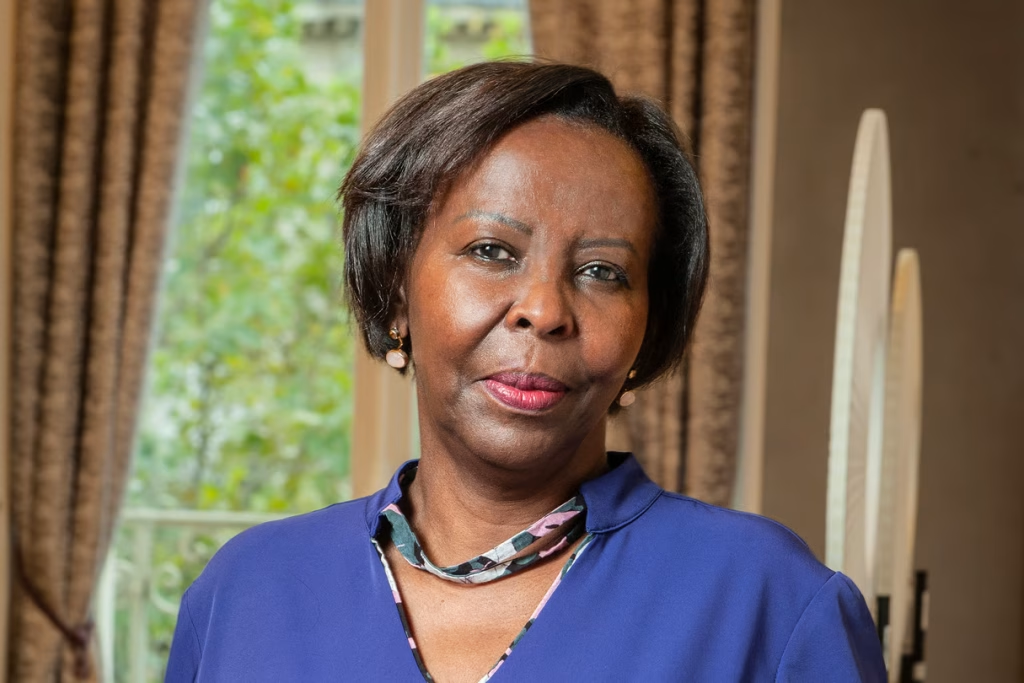
Mushikiwabo is the current Secretary General of La Francophonie and is seeking a third term.
She was first elected to the position at the Francophonie Summit in Yerevan, Armenia, in October 2018 and took office in January 2019. She was re-elected for a second four-year term at the Djerba Summit in 2022.
Before joining the OIF, Mushikiwabo served as Rwanda’s Minister of Foreign Affairs and Cooperation from 2009 to 2018, after previously serving as Minister of Information.
Her career has largely centred on diplomacy and international relations, and she is campaigning on her record leading the organisation over the past eight years.
Juliana Amato Lumumba

The Democratic Republic of the Congo is represented in the race by Juliana Amato Lumumba, daughter of the country’s independence figure and first Prime Minister, Patrice Lumumba.
She previously served in government, including as Minister of Culture, and later served as Secretary General of the Union of African Chambers of Commerce, Industry, Agriculture and Professions.
The DRC presented her candidacy as part of its push for a more modern and influential Francophonie.
During her campaign, Lumumba has advocated reforms aimed at making the organisation more effective and responsive to its member countries, including initiatives focused on peace and the peaceful resolution of disputes.
Coumba Bâ

Mauritania’s candidate, Coumba Bâ, has held several senior positions in government and public service.
She has previously served in ministerial positions covering areas including public service, youth and sports, and African affairs.
Bâ is currently serving as a special representative of Mauritanian President Mohamed Ould Cheikh El Ghazouani on matters related to La Francophonie, and Mauritania has mounted a diplomatic campaign in support of her candidacy.
Her professional background also includes medicine, having trained as a dental surgeon before entering public service.
Dacian Cioloș

Romania’s Dacian Cioloș is the only European candidate in the four-way race.
The Romanian politician and agronomist served as Prime Minister of Romania and previously held senior positions dealing with agriculture at both national and European Union levels.
He later served in the European Parliament, where he led the Renew Europe political group.
Romania formally submitted his candidacy, putting forward his experience in government, European institutions and agricultural development as part of his bid to lead La Francophonie.
The four candidates are seeking to lead an organisation that brings together 90 states and governments, including full members, associate members and observers.
The final decision will be made by the heads of state and government of the OIF’s full member countries during the 20th Francophonie Summit in Phnom Penh, Cambodia.
The election is scheduled for November 16, with the successful candidate set to lead the organisation during the 2027–2030 term.
RADIOTV10