
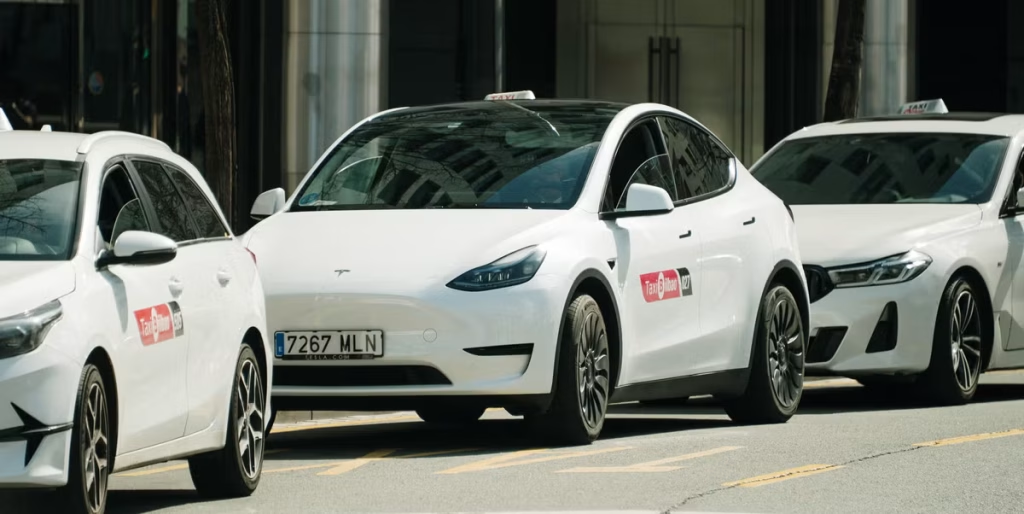
Tesla’s driverless taxis are already carrying passengers in parts of the United States, raising questions about whether cars that operate without drivers could eventually challenge traditional taxi businesses and change the future of public transport.
The company expanded its Robotaxi service to Fort Worth, Texas, on November 2, 2026, bringing the service to seven American cities. The expansion comes as Tesla introduces a new type of taxi that can carry passengers without anyone sitting behind the steering wheel.
For passengers, the experience is simple but unusual. They order a car through an application, enter when it arrives and travel to their destination while the vehicle drives itself.
Tesla has also introduced the Cybercab, a two-seat vehicle built without a steering wheel or pedals. It began carrying paying passengers in limited parts of Austin, Texas, in September.
The development raises an important question for the transport industry: if passengers can travel without a driver, what will happen to businesses that depend on people driving taxis?
One of the biggest attractions of driverless taxis is the possibility of reducing transport costs.
Traditional taxi businesses pay drivers or share earnings with them. A self-driving taxi could operate without that expense, although companies would still need to pay for vehicles, maintenance, insurance, electricity and customer support.
Tesla hopes that operating more driverless vehicles will eventually make rides cheaper and easier to access.
However, early passenger experiences show that driverless taxis are not necessarily cheaper than ordinary taxis.
In September, American motoring publication MotorTrend tested Tesla’s Cybercab in Austin, taking five journeys covering approximately 11.5 miles.
The trips cost a total of $33.72, with individual fares ranging from $4.73 to $11.44.
The journalist described the rides as smooth but found that the vehicle sometimes stopped several minutes’ walk from the requested destination.
Another journalist from Axios paid approximately $12 for a four-mile journey and reported a similar problem with the drop-off location.
These experiences show that the technology is already working in real traffic, but the convenience and cost of the service still vary.
Tesla is not the only company introducing cars that can carry passengers without drivers.
Waymo, owned by Google’s parent company Alphabet, has also expanded its driverless taxi services across several American cities.
By March 2026, Waymo reported providing approximately 500,000 paid rides every week across ten cities.
The figures show that driverless transport is moving beyond small demonstrations and attracting growing numbers of passengers.
For traditional taxi businesses, the competition could eventually become significant if driverless vehicles become cheaper, more reliable and widely available.
Passengers might choose between a human-driven taxi and a self-driving vehicle based on price, waiting time and convenience.
Taxi operators could also face pressure to change how they run their businesses, while new opportunities could emerge in vehicle maintenance, fleet management and customer support.
However, driverless taxis currently operate only in selected areas, and their long-term effect on driving jobs remains uncertain.
Although these services are currently concentrated in the United States, their expansion raises interesting questions about the future of transport in Rwanda.
Kigali already has conventional taxis, motorcycle taxis and transport services that allow customers to request rides
Before driverless taxis could operate locally, authorities would also need to establish whether the vehicles can safely handle local traffic conditions, including motorcycles, pedestrians and busy junctions.
The cost of the vehicles and the ability of transport companies to maintain them would also influence whether such services could become practical.
For people working in the transport sector, the technology presents both opportunities and questions about the future of their jobs.
Despite the progress, driverless taxis still face challenges that traditional taxi services have already learned to manage.
Some vehicles operate only within selected areas, while passengers may experience longer routes, difficulties with pick-up locations or delays during busy periods.
Safety is another major concern. Regulators in the United States are examining how self-driving vehicles meet road safety requirements, including Tesla’s Cybercab, which lacks conventional driving controls.
Tesla must also demonstrate that its vehicles can operate reliably in different traffic and weather conditions as the service expands.
Traditional taxis still offer advantages, including drivers who can respond directly to passengers, change routes when necessary and assist people who need additional help.
The growing number of driverless taxis therefore does not mean human drivers are about to disappear.
What is changing is that passengers are beginning to have another choice.
As Tesla and other companies expand their services, the future of taxi businesses may depend on which option offers passengers the best combination of price, safety and convenience.
For now, the competition has begun in selected cities abroad. Whether driverless vehicles eventually transform transport worldwide remains an open question.
Elie GATETE
RADIOTV10