
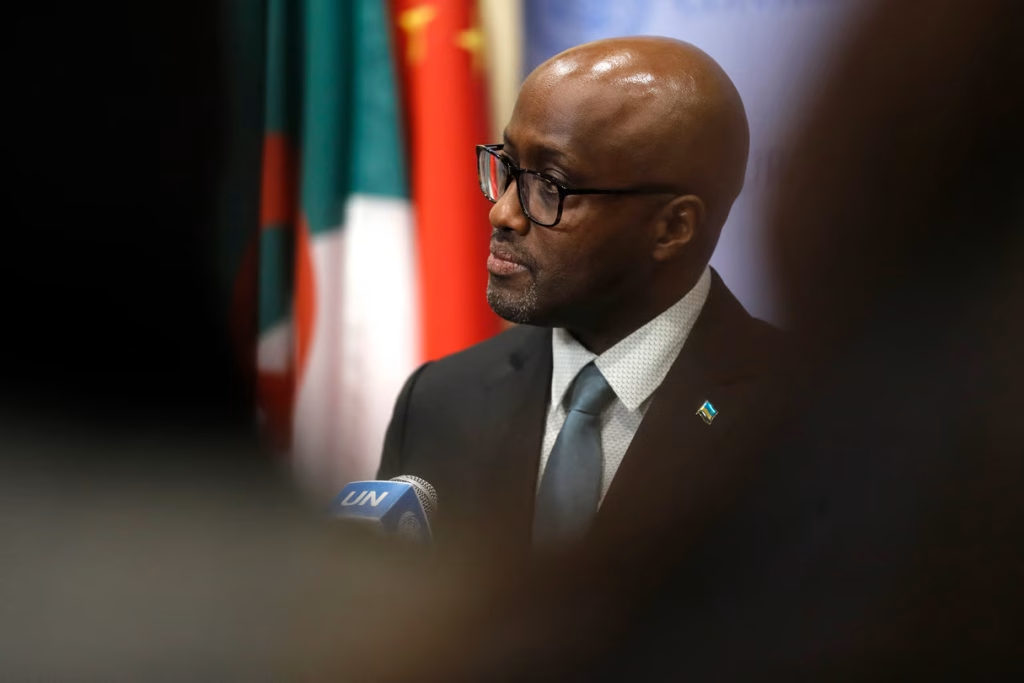
Foreign Affairs and International Cooperation Minister Olivier Nduhungirehe said Rwanda maintains good relations with many countries, although ties with some countries in the region and Belgium remain strained.
Speaking in an interview with Mama Urwagasabo, Nduhungirehe said Rwanda’s diplomacy is focused on building cooperation, expanding trade and attracting investment rather than taking sides in disputes between other countries.
“Our first priority is to build good relations with countries so that we can cooperate, promote trade and investment, and pursue our goal of self-reliance. We also want to trade among ourselves and develop as Africans,” he said.
He added that Rwanda’s foreign policy is not based on choosing one side over another when other countries are in conflict.
“Our policy and our diplomacy are not about choosing one side against another, because those are issues concerning those countries,” Nduhungirehe said.
Rwanda and Belgium
Relations between Rwanda and Belgium have remained strained since Rwanda severed diplomatic ties with Belgium in March 2025 and ordered Belgian diplomats to leave the country within 48 hours.
The Government of Rwanda said at the time that Belgium had taken sides in the regional conflict involving Rwanda and the Democratic Republic of Congo. Belgium rejected Rwanda’s accusations and later announced reciprocal diplomatic measures.
Nduhungirehe said some interaction between the two countries continues, particularly because Rwandans live in Belgium and Belgians live in Rwanda, but no decision has been made to restore diplomatic relations.
“We have not yet made a decision, but talks are taking place between Rwanda and Belgium… No step has been taken, I would say, to indicate that we have decided to restore diplomatic relations,” he said.
Rwanda and Tanzania
On Tanzania, Nduhungirehe said relations between the two countries were good, pointing to their joint commission meetings and President Paul Kagame’s visit to Tanzania.
He also cited trade as an important part of the relationship, noting that much of Rwanda’s imported cargo passes through Tanzania.
“Relations are good. We also have trade relations. Much of what we import from abroad passes through Tanzania via the Port of Dar es Salaam, and there is also the Port of Tanga,” he said.
Rwanda and Tanzania have continued bilateral talks on trade and regional cooperation. During a visit to Tanzania in July, Nduhungirehe said about 80% of Rwanda’s maritime cargo passes through the Port of Dar es Salaam.
Relations With Burundi Remain Difficult
Nduhungirehe said Rwanda and Burundi had previously held talks aimed at reducing tensions between the two countries, but the discussions did not continue.
He said that after AFC/M23 took Goma and Bukavu, security and intelligence officials from Rwanda and Burundi met at the border to discuss ways of addressing security concerns.
According to Nduhungirehe, Burundian President Evariste Ndayishimiye later told international media that Rwanda intended to attack Burundi. He said this prompted Burundi to halt the talks.
Another round of talks involving security and intelligence officials from the two countries took place in December 2025, after AFC/M23 took Uvira. Nduhungirehe said the meetings were held on December 14 and 28 with support from the United States, but President Ndayishimiye later again made accusations against Rwanda.
“Sometimes you have the political will to engage with a neighbouring country and its government representatives, but it becomes difficult when the president of that country goes to the media and says something different from what you agreed,” Nduhungirehe said.
On soldiers and other people Burundi accused of involvement in the attempted overthrow of former President Pierre Nkurunziza in 2015, Nduhungirehe said there had been no discussions between Rwanda and Burundi in 2026 about handing them over.
“This year, 2026, there have been no talks at all between Rwanda and Burundi,” he said.
Nduhungirehe said Rwanda’s main concern was security in the region. He accused Burundian forces of working with Congolese forces and the Democratic Forces for the Liberation of Rwanda (FDLR) in activities Rwanda says threaten its security.
How Did the DRC-FDLR Protocol Come About?
Nduhungirehe also spoke about a protocol between the Congolese government and the FDLR covering the disarmament, demobilisation and cantonment of the group’s fighters, saying Rwanda did not view it as a new measure that was necessary.
DRC officials, including Regional Integration Minister Floribert Anzuluni and government spokesperson Patrick Muyaya, announced in July that the FDLR had agreed to a protocol on disarmament, demobilisation and cantonment. Congolese authorities presented it as part of implementing commitments under the Washington peace process.
Nduhungirehe said the protocol could distract from implementation of the Washington agreements, arguing that the process for disarming and neutralising the FDLR had already been set out under the existing framework. The Joint Security Coordination Mechanism established under the Rwanda-DRC peace agreement is tasked with implementing the plan for neutralising the FDLR alongside Rwanda’s disengagement of forces and lifting of defensive measures.
“Congo went and sat down with the FDLR and came back with what they call a nine-month ‘protocol’. They also introduced things that were never mentioned in the Washington agreement, including saying that Rwandan refugees should not return to Rwanda and that another country should be found for them,” Nduhungirehe said.
He added that Rwanda would not accept people he accused of involvement in the 1994 Genocide against the Tutsi returning to Rwanda and freely engaging in politics.
“That protocol between the FDLR and the Congolese government is intended to divert attention, distract us and delay us, yet the Washington Agreement has a clear way in which it must be implemented,” he said.
Nduhungirehe has previously rejected the DRC-FDLR protocol, while the Congolese government has described it as part of its implementation of the Washington commitments.
He criticised what he described as other steps taken by the DRC that were contrary to the Washington agreements and questioned why the mediator and other countries involved in the process had not acted.
Nduhungirehe said Rwanda would continue preparing to defend itself against anything that could threaten its security while remaining committed to implementing the agreements it has signed.
RADIOTV10